
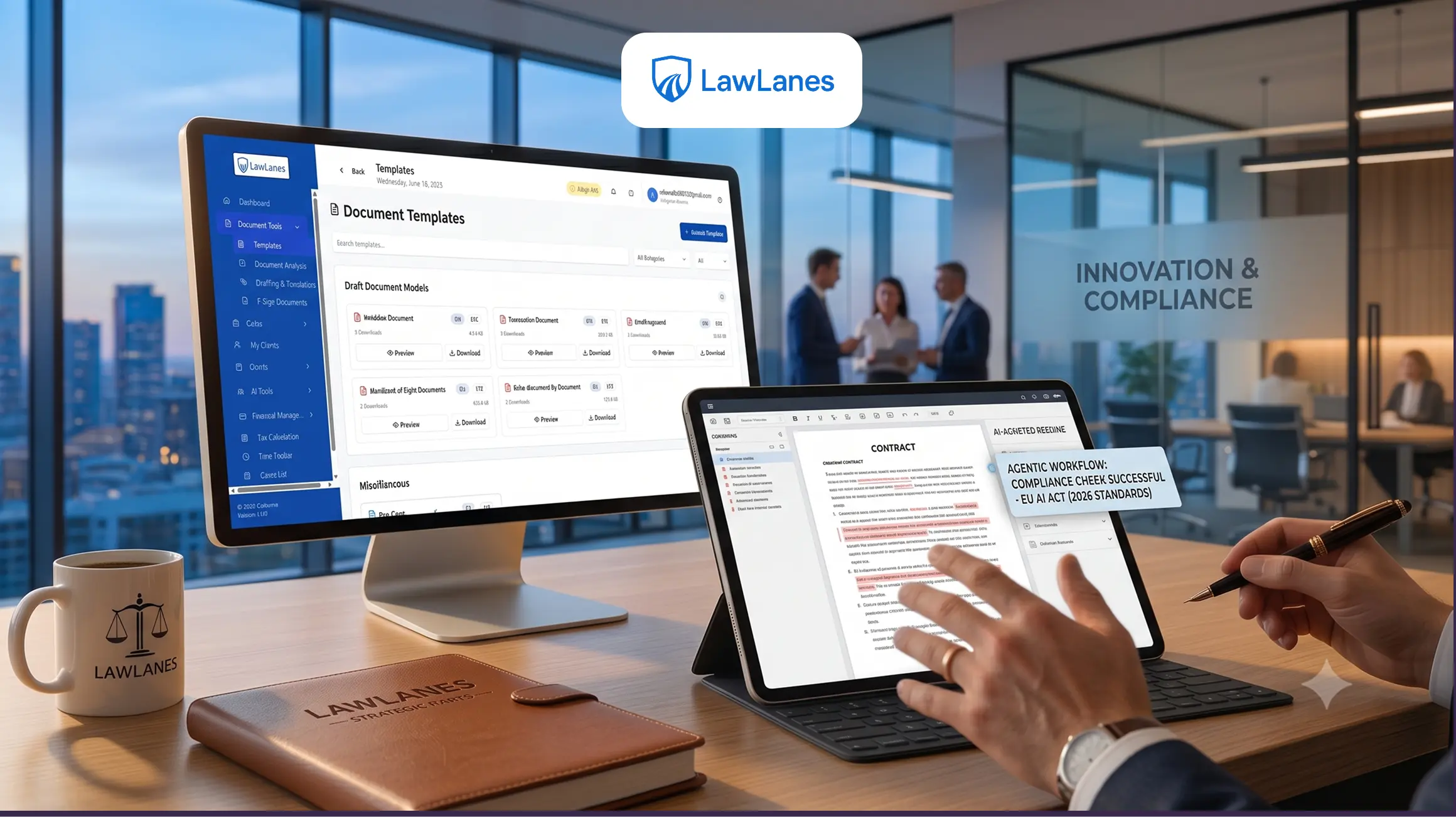
The pilot phase of artificial intelligence in corporate legal departments is officially over. According to data tracked by the Association of Corporate Counsel (ACC) and Ever law, corporate legal adoption of generative AI more than doubled within a breakneck twelve month window, skyrocketing from 23% to 54%. We are no longer discussing whether machines can draft a basic non-disclosure agreement or parse simple contract clauses. Instead, as we navigate 2026, the structural landscape of the legal sector is experiencing a fundamental rewrite.
Today, AI is transforming legal practice in 2026 by migrating from reactive, prompt based chatbots to autonomous, multi step agentic systems. General Counsel and Big Law managing partners are shifting their capital allocations away from siloed point solutions toward highly integrated, enterprise-grade cognitive architectures. This evolution is redrawing the boundaries of operational efficiency, reshaping internal corporate power dynamics, and presenting entirely new frameworks for global regulatory compliance.
The Legacy Bottleneck: Why Point Solutions and Reactive AI Failed the Enterprise
During the early waves of generative AI deployment, legal teams quickly ran into structural walls. The initial strategy relied heavily on general-purpose Large Language Models (LLMs) to perform ad-hoc tasks. While these tools showed immense promise for isolated summaries, they introduced significant corporate liabilities that made them unsustainable for scale operations.
First, the financial implications of unmanaged legal tech stacks became painfully evident. Gartner recently highlighted that a massive share of early agentic AI pilots faced cancellation due to escalating API costs and poorly defined business value metrics. Second, systemic data integrity vulnerabilities emerged. A landmark U.S. federal court ruling established that utilizing public or unencrypted generative AI engines without strict contractual data-isolation guarantees directly compromises attorney client privilege and work-product doctrine protections.
Furthermore, reactive AI systems placed the operational burden back on the attorney. A human lawyer still had to engineer the prompt, review the standalone output for hallucinations (which have resulted in public court sanctions worldwide), and manually move the data between the AI interface, the Document Management System (DMS), and enterprise risk registers. This manual friction limited productivity gains, keeping legal operations tethered to the traditional, billable hour paradigm that resists systemic scaling.
The Architectural Shift: Agentic AI and Specialized Corporate Context
In 2026, the competitive advantage has shifted completely away from the underlying generic LLM baseline. The value layer now resides within an organization’s proprietary, structured knowledge base precedents, internal regulatory playbooks, and historical contract metadata. Enterprise legal frameworks are evolving into proactive infrastructure engines.
Leading institutions are actively deploying task-specific AI agents that operate with a deep understanding of corporate context. Rather than waiting for an attorney to ask a question, an agentic system autonomously monitors incoming contract streams, extracts risk variables, references internal compliance guidelines, cross analyzes data against dynamic global regulations, and routes redlined drafts directly to the appropriate stakeholder checkpoints. Tech integration giants like Microsoft, IBM, and specialized legal technology suites are delivering these multi-layered workflows to maintain precise human in the loop auditability.
This structural change directly impacts resource allocation. Upwards of 64% of in house legal departments report that they actively intend to cut their reliance on external law firms for routine transactional work, regulatory mapping, and high volume discovery. By bringing contract drafting and first-pass analysis entirely in house through hyper specialized AI systems, corporations are unlocking massive operational efficiency while building data driven defensive moats around their internal IP.
Optimize Your Legal Infrastructure for the Agentic Era
Managing the intersection of autonomous legal workflows, strict security parameters, and verifiable ROI requires a purpose built foundation.
The Lawlanes Enterprise Legal Engineintegrates seamlessly into your existing corporate tech stack, providing secure, localized document intelligence, automated compliance auditing, and advanced multi file risk analysis without sacrificing attorney oversight.
Schedule an Enterprise Architecture Consultation with Lawlanes Today →
Evaluating the Evolution: Legal Operations Archetypes
To maximize Return on Investment (ROI) and minimize operational risk, enterprise buyers must differentiate between outdated rule based software and modern agentic architectures. The table below outlines the structural performance shifts observed across the industry:
| Operational Attribute | Traditional / Rule-Based Systems | Reactive GenAI (2024–2025) | Agentic Legal AI (2026 Paradigm) |
|---|---|---|---|
| Workflow Execution | Strictly manual input; rigid “if-this-then-that” formatting. | Prompt-dependent; outputs single answers to isolated questions. | Autonomous; plans and executes multi-step workflows across systems. |
| Contextual Awareness | Zero internal context; limited to predefined keyword fields. | Broad public internet context; prone to generic formatting. | Deep integration with proprietary templates and company precedents. |
| Risk & Hallucination Profile | Low flexibility, but deterministic and highly predictable. | High risk of hallucinated case citations without verification layers. | Mitigated via strict retrieval-augmented validation frameworks. |
| Regulatory Compliance | Requires manual audits to match updating regulatory parameters. | Difficult to audit; lacks structured, reproducible data logs. | Built-in compliance tracking aligned to the strict EU AI Act standards. |
Implementation Playbook: Deploying Enterprise Legal AI Securely
Transitioning to an AI-driven legal framework requires a phased execution roadmap to ensure data security, legal defensibility, and user adoption. Follow this structured protocol to execute the migration seamlessly:
Audit and Centralize Proprietary Data Assets: Clean, structure, and index your internal historical contract repositories, execution precedents, and corporate policies. This corpus forms the localized retrieval framework for your AI models.
Establish Secure, Zero-Training Infrastructure: Deploy legal-specific AI systems via sovereign cloud instances or dedicated endpoints that guarantee customer data is contractually isolated and never used for base model training.
Deploy Task-Specific Guardrails and Human-in-the-Loop Controls: Map out explicit validation checkpoints where human attorneys must verify complex analytical outputs, keeping accountability anchored to professional standards.
Integrate Cognitive Agents Across the Existing Tech Stack: Interconnect your document management architectures, enterprise billing tools, and risk registers via secure APIs to build a cohesive legal ecosystem.
Execute Mandatory Upskilling and AI Literacy Programs: Train your legal team to critically evaluate AI outputs, verify citations, and master advanced context prompting to satisfy modern professional competence mandates.
Critical Vulnerabilities: Common Mistakes in AI Legal Implementations
Even highly sophisticated technology teams stumble when deploying AI within the risk-sensitive boundaries of the legal department. Avoid these major execution errors:
Treating Legal AI as a Generic IT Commodity: Deploying general purpose productivity models without legal specific tuning leads directly to syntax errors, missing context, and compliance failures. The Fix: Prioritize platforms explicitly trained on rigorous legal corpuses.
Neglecting Comprehensive Audit Logs: Failing to maintain an immutable record of how an AI system arrived at a specific contract interpretation or risk assessment creates severe defensibility gaps. The Fix: Implement systems that output step by step reasoning chains and explicit source mapping for every analytical decision.
Ignoring Jurisdictional Compliance Timelines: Overlooking structural global regulations such as the EU AI Act taking effect in August 2026, which classifies legal AI applications under high-risk transparency mandates exposes enterprises to multi-million dollar penalties. The Fix: Ensure your vendors provide native compliance frameworks that conform completely to localized privacy laws.
Enterprise Recommendations & Security Checklist
Before moving any production workloads to automated systems, ensure your internal infrastructure meets the following gold standards outlined by leading consultancies like Deloitte and McKinsey:
The Enterprise Security & Compliance Imperative: Every legal AI implementation must support verifiable data sovereignty, end-to-end encryption, SOC 2 Type II validation, and explicit role-based granular access controls to preserve core corporate privileges.
- Verify your provider completely isolates your prompt inputs and model outputs from public data streams.
- Deploy automated compliance tracking systems that adjust to moving legislative boundaries in real time.
- Incorporate dynamic pricing models or localized open-source orchestration to protect long term ROI from skyrocketing commercial API costs.
Key Takeaways for Executive Leadership
- AI is transforming legal practice in 2026 by transitioning completely to proactive, multi-step agentic workflows that orchestrate tasks autonomously.
- Specialized corporate knowledge, structured templates, and deep system integrations have completely superseded generic LLMs as strategic assets.
- Corporate legal departments are leveraging intelligent infrastructure to rapidly reduce reliance on expensive outside counsel.
- Compliance with stringent frameworks like the EU AI Act requires rigorous, documented human oversight and transparent audit tracking.
Conclusion: Building the Future-Proof Legal Architecture
The structural integration of artificial intelligence into the legal sector is no longer an experimental initiative designed for marginal efficiency boosts. It represents a permanent evolution in how corporations manage risk, execute agreements, and navigate complex regulatory landscapes. By focusing on deep systems integration, strict data governance, and specialized agentic applications, modern enterprises are building lean, highly powerful legal engines that scale effortlessly alongside business growth.
To successfully navigate this operational transformation, your organization requires an infrastructure provider built specifically for enterprise security and complex workflow automation.
Connect with the corporate systems team at Lawlanes to review our specialized solutions, secure your data assets, and deploy robust, compliant legal AI architectures across your global enterprise operations.
Frequently Asked Questions
How exactly is AI transforming legal practice in 2026 compared to earlier implementations?
In 2026, the industry has transitioned from reactive AI engines that merely respond to static prompts to agentic systems. Modern legal AI autonomously executes multi step workflows, manages contract lifecycles, and integrates directly with enterprise applications while preserving human in the loop validation checkpoints.
What are the critical compliance requirements for legal AI systems under the EU AI Act?
Enforced starting August 2026, the EU AI Act categorizes specific legal AI applications as high risk. This demands absolute transparency, verifiable risk management architecture, immutable audit logging, and formal human oversight mechanisms to protect consumers and organizations alike.
Can using generative AI compromise corporate attorney client privilege?
Yes. If corporate data or legal queries are fed into consumer grade or unstructured public models, the data may be retained for training purposes, which legally waives confidentiality protections. Enterprise frameworks must utilize isolated, non training environments to ensure total privilege preservation.
How are corporate legal departments proving the financial ROI of agentic software?
Organizations measure ROI by calculating the reduction in cycle times for high-volume contract execution, lower headcount additions relative to transaction growth, and a significant reduction in outside counsel spend by migrating complex drafting tasks back in house.
What role do legal specific AI models play versus general models from OpenAI or Anthropic?
While foundational LLMs offer incredible baseline language reasoning, legal-specific platforms adapt these engines or build specialized retrieval systems (RAG) loaded with specialized legal syntax, strict citation verifications, and custom metadata parsing tools that eliminate general model hallucinations.
How should an enterprise address the risk of AI hallucinations in litigation or contract management?
Firms must establish explicit retrieval augmented verification pathways. Every analytical point, case reference, or clause alteration generated by the AI must map directly back to a verified primary source document, ensuring zero reliance on unverified generative data.